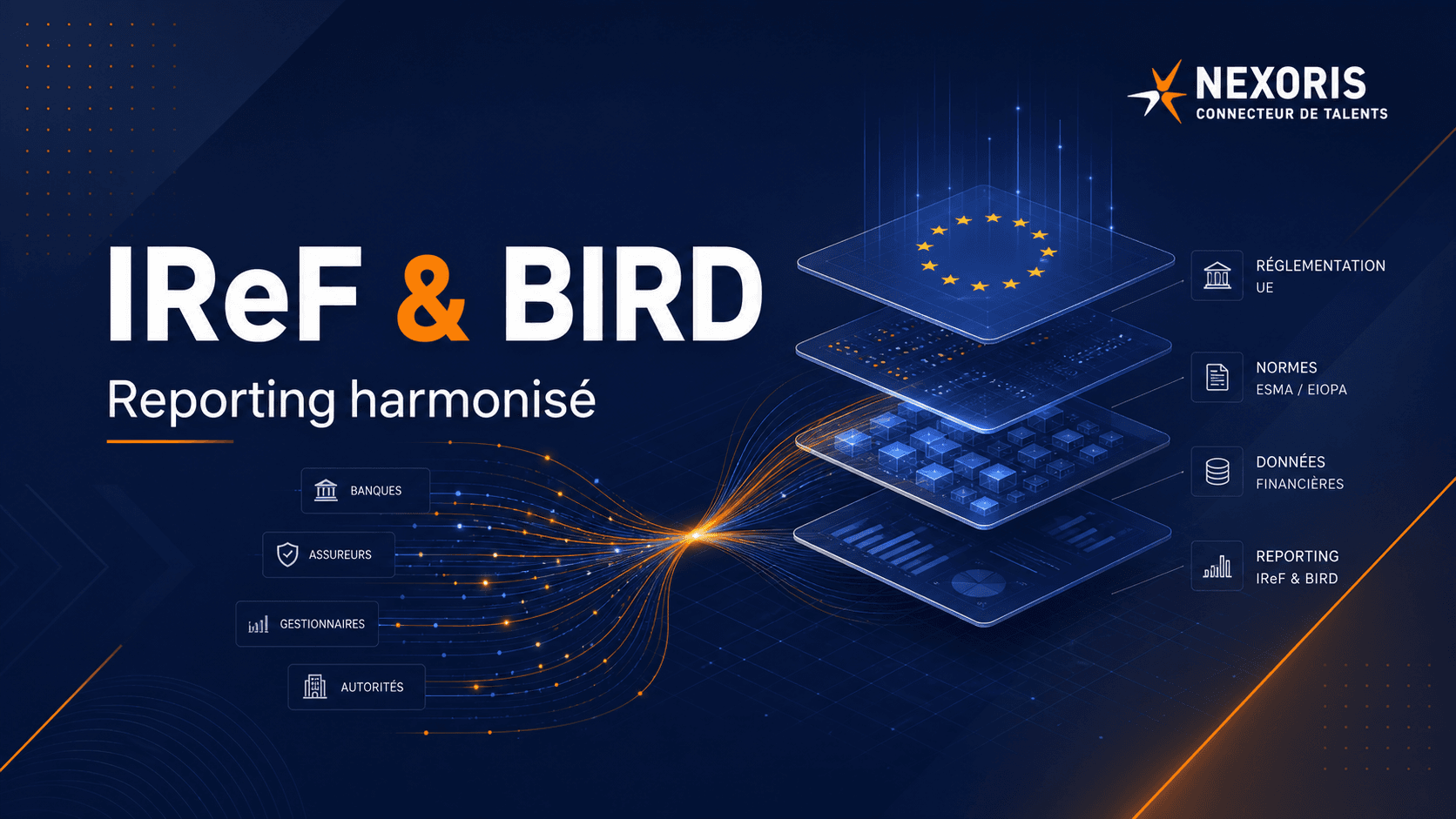
The European regulatory framework continues to evolve with the emergence of two major initiatives led by the Eurosystem and the European Central Bank (ECB): IReF (Integrated Reporting Framework) and BIRD (Banks' Integrated Reporting Dictionary). These projects aim to simplify, standardize and strengthen the reliability of reporting obligations for financial institutions in the euro area.
Goals and regulatory framework
The IReF project aims to centralize and unify banks' statistical reporting requirements, currently fragmented across multiple frameworks (FINREP, COREP, AnaCredit, etc.). Built on a common, granular data model, it aims to:
- reduce redundancy in reporting;
- improve the quality of the data submitted;
- make exchanges between banks and authorities easier to automate and supervise.
BIRD, on the other hand, is a standardized dictionary of data and transformation rules. It serves as a technical reference helping institutions align their internal information systems with Eurosystem reporting requirements.
These two initiatives are designed to work together, with the goal of delivering a lasting, consistent simplification of the reporting process.
Companies affected
Mainly affected are:
- credit institutions operating in the euro area;
- supervised entities under the ECB or national central banks;
- European subsidiaries of international banking groups.
Indirectly, Consulting firms, IT Services Companies and independent experts are also affected, as the players brought in to support this regulatory and technical transformation.
Implementation timeline
According to the indicative timeline published by the ECB, IReF is expected to be rolled out gradually starting in 2027, with pilot phases and tests as early as 2024-2025 in several countries, including France.
BIRD, meanwhile, is already being used by some banks as a tool to prepare for the transition.
⚠️
Specific challenges for banks in implementing IReF and BIRD
Banks need to approach IReF/BIRD not as a simple regulatory project, but as a deep transformation of their regulatory data processing chain. This calls for stronger governance, fit-for-purpose tools and a clear strategy on the resources to mobilize. The shift raises several key challenges:
🔧 1. Modernizing data architectures
- IReF relies on granular data, often spread across different internal systems.
- Data warehouses, models and flows need to be rethought to ensure consistency, completeness and quality.
↺ 2. Transforming internal processes
- Moving toward processes that are updated more frequently, automated and controlled.
- Stronger collaboration across business, risk, finance, IT and compliance.
👥 3. Mobilizing scarce skills
- Hybrid profiles in demand: regulatory, data, architecture, tooling.
- Tight market: external reinforcements need to be planned ahead of time.
📉 4. Managing operational risks
- Critical data that must be handled with precision.
- Need for robust controls, documentation and traceability.
💰 5. Costs and budget priorities
- Long, multi-phase projects (impact assessment, migration, testing, etc.).
- Competing with other strategic internal initiatives.
🔍 6. Regulatory anticipation and adaptability
- IReF specifications still evolving until 2027.
- A modular, iterative and flexible approach is essential.
📊 The structural reports integrated into IReF
IReF aims to unify several regulatory reports that are currently handled separately. The main ones are:
- FINREP: consolidated financial statements (balance sheet, income statement, asset quality) under IFRS.
- COREP: data on own funds, capital requirements and risks (credit, market, operational).
- AnaCredit: granular information on loans extended to companies.
- MMSR: data on short-term money market operations (€STR).
- SHS: data on securities held by banks (exposures, systemic risks).
Bringing these reports into a common data architecture will reduce the reporting burden, improve data quality and strengthen consistency across Europe.
🧬 BIRD: a dictionary, not a report
BIRD (Banks' Integrated Reporting Dictionary) isn't a report, but a data and transformation rules reference made available by the Eurosystem.
It provides:
- a standardized description of internal source data (loans, collateral, securities, counterparties, etc.);
- transformation rules to produce the expected reports;
- structural alignment with the requirements of the ECB, the EBA and national central banks.
BIRD acts as a toolkit to:
- make data systems easier to bring into compliance;
- reduce adaptation costs;
- prepare effectively for the transition to IReF.
🧠 RegTech solutions: tools supporting IReF/BIRD compliance
Implementing IReF and BIRD comes with a growing need for technology tools to automate, strengthen and document regulatory processing. RegTech solutions (Regulatory Technology) address these challenges.
They operate at several levels:
- data collection and standardization;
- transformation according to BIRD rules;
- file generation (XBRL, XML, SDMX, etc.);
- quality controls, traceability, audit;
- ongoing adaptation to evolving standards.
Examples of solutions in use:
- AxiomSL (Adenza), Regnology (Abacus), Wolters Kluwer OneSumX: multi-standard reporting.
- Collibra, Informatica, Talend: data lineage, dictionaries, quality.
- SAS Regulatory Content, BearingPoint FiTAX, and scalable in-house solutions.
- Sandbox BIRD and specialized frameworks from IT Services Companies and Consulting firms.
🔧 Key skills to deliver IReF/BIRD projects
Delivering these projects requires a mix of skills:
- Regulatory project management: coordination, planning, ECB/ACPR liaison.
- Reporting expertise: knowledge of FINREP, COREP, AnaCredit, MMSR and SHS frameworks.
- Data architecture: modeling, governance, dictionaries, traceability.
- Technologies: SQL, Python, ETL, BI, RegTech and reporting platforms.
- IReF/BIRD knowledge: understanding of the models and rules, plus practical implementation experience.
🤝 How Nexoris can support the players involved
Nexoris provides operational support to the various players dealing with IReF and BIRD implementation:
For financial institutions
We help them identify and bring on board qualified consultants specialized in project management, regulatory expertise or data management. These experts, whether independent or working at a firm, can step in at any phase of the project.
For Consulting firms and IT Services Companies
Nexoris streamlines the sourcing of profiles of specialized independent experts to complement the teams already deployed at their banking clients. Nexoris also offers Payroll Management Services to make their engagements with major market players easier.
In closing
Whether it's IReF/BIRD or other regulatory, business, organizational or technology transformation programs, Nexoris offers targeted, hands-on support to financial institutions and to professional services players alike.
More about the article's author
After starting his career in banking and then in financial information, Olivier Le Coquil became an independent consultant in 2010 and founded Nexoris, then two umbrella companies, Nexoris Portage and Plug&Pay Portage Salarial - the latter dedicated to the world of interim management.
In a few years, together with Emmanuel Mahe and their teams, he built an ecosystem around freelancing, IT Services Companies, Consulting firms and interim management at the service of Key Accounts.